

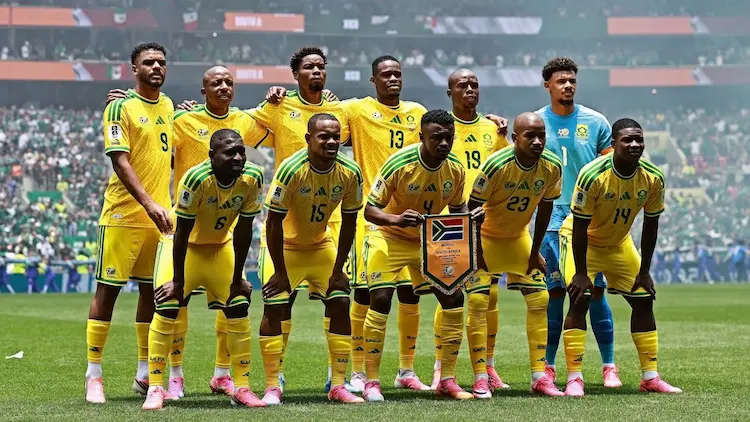
After the worst possible start with a 2-0 defeat to Mexico in the opening game where they had two players sent off, Bafana rallied to draw 1-1 with Czechia with Teboho Mokoena netting a vital 83rd minute equaliser from the penalty spot.


Hugo Broos’ team then sensationally defeated South Korea 1-0, via a 63rd minute Thapelo Maseko goal to set up a last 32 encounter with another of the co-hosts, Canada.
A stoppage time goal from Stephen Eustaquio was all that separated the two sides as Bafana crashed out of the global showpiece – that was ultimately won by a Rodri-inspired Spain against a very negative Argentina, with Ferran Torres the hero with his extra-time strike.
Luis De La Fuente’s Spain were widely regarded as the best team of the tournament, as they stuck to their principles, with a clear game-plan that effectively combined defensive solidity with purposeful possession. Their high pressing, dominant midfield and technical excellence made Spain a difficult team to break down, and a real threat going forward, either through the middle of the park or on both flanks.
Semi-finalists Argentina, France and England each displayed their own distinctive styles, while the likes of Norway and Morocco played some effective football during their run to the quarter-finals.
READ: FIFA Launches Probe Into Spain-Argentina World Cup Final Brawl
Bafana’s run to the Round of 32 in 2026 showed progress, but also highlighted what separates the nearly-rans from genuine title contenders.
One recurring theme throughout the tournament, particularly in the latter stages, was the contrast in tactical approaches, with one team often adopting a more expansive, attack-minded style while the other relied on a more compact, defensive approach.
Time and again the teams that sat back and defended were ultimately picked off and eliminated from the competition.
In their first game against Mexico, the South Africans set up in an unfamiliar 5-3-2 system in an attempt to negate the attacking threat from Eli Tri. Needless to say that this tactic back-fired, as it did for England in their semi-final with Argentina and in the final, with Lionel Scaloní’s side seemingly refusing to play football.
In tighter and less controversial matches, the difference between winning and losing often came down to key decisions from the bench.
Substitutes played a significant role in the outcomes of games, with veteran striker Romelu Lukaku scoring three goals off the bench for Belgium as they exited at the quarter-finals with a 2-1 defeat to La Furia Roja.
Mikel Merino came off the bench for Spain to score winning goals against both Portugal, in the round of 16, and against Belgium, while Bradley Barcola was also effectively used off the bench for France.
The top sides all had the luxury of introducing players capable of changing the rhythm of a match.
Bafana restored to type with a more attacking playing style the longer the tournament progressed and ultimately reaped the benefits to progress to the knockout rounds, only for Broos to lose faith in his team’s ability to play against Canada, and removed the likes of Relebohile Mofokeng at half-time.
While the North Americans reinforced their team with five substitutions during the second half, Broos left it until the 86th minute to make changes, with the introduction of Iqraam Rayners for Evidence Makgopa and Tshepang Moremi for Thapelo Maseko – but by then the momentum was fully with Canada and they netted the winner just six minutes later.
Bafana were, however, ultimately eliminated from the competition due to a lack of belief, stemming from a distinct lack of experience at the highest level.
While the majority of the top sides relied heavily on their star players, notably Lionel Messi, Kyllian Mbappe, Harry Kane, Spain’s squad was littered with seasoned winners, as Bafana looked to (at times) a 21-year-old Mofokeng to provide a creative spark.
With only six of Broos’ players representing club teams outside of the country, South Africa would be wise to take the ultimate lesson from this World Cup, from Champions Spain and invest heavily in adopting clear football identity, underpinned by elite youth academies with strong coaching education with the ability to identify and develop talent in a strong domestic league.